Free section
American Government: US Citizenship Test Practice Questions
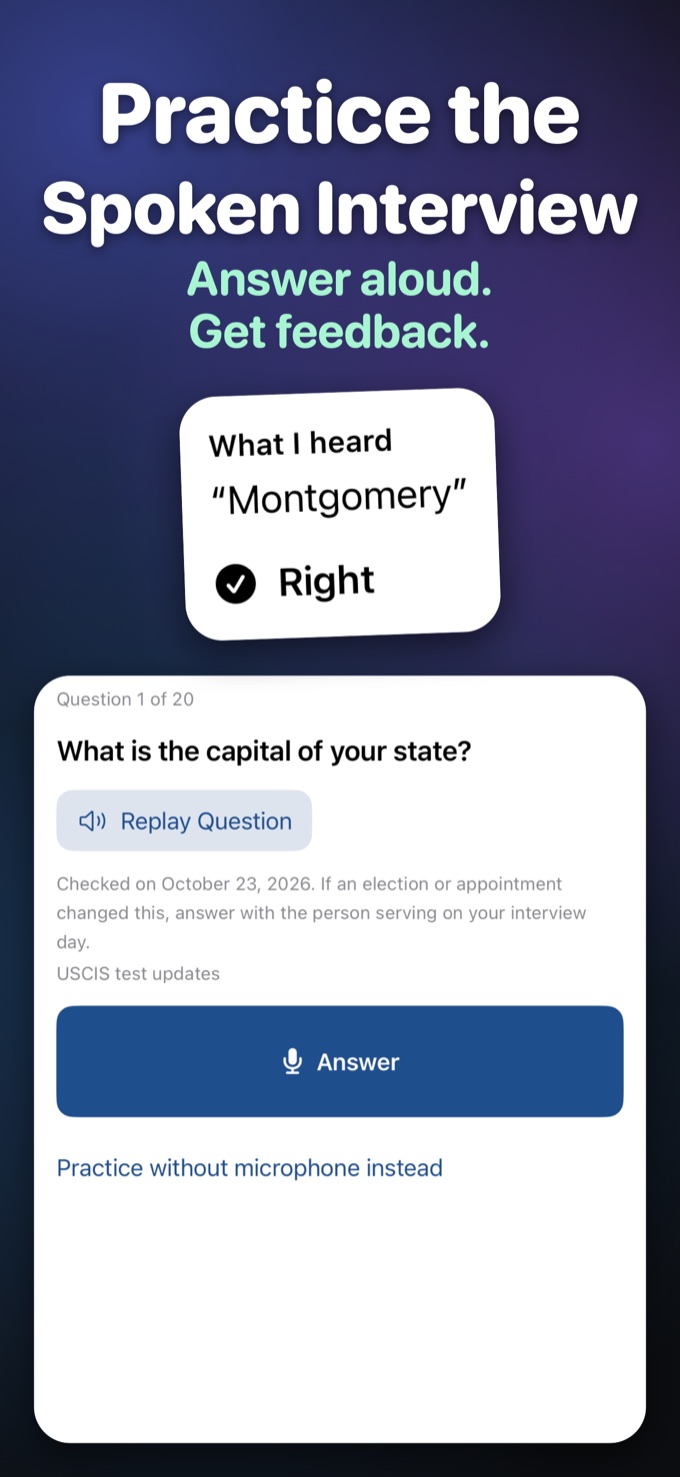
64 practice questions from this part of the 2025 civics test. Answer out loud, then open “Show answer” to check it and read the explanation.
1. What is the form of government of the United States?
Show answer
Accepted answers:
Republic Constitution-based federal republic Representative democracy The United States is a republic: the people elect representatives to govern for them, under the Constitution.
2. What is the supreme law of the land?
Show answer
Answer: (U.S.) Constitution
The Constitution is the land’s supreme law. Everyone in the United States, including every government, must follow it.
3. Name one thing the U.S. Constitution does.
Show answer
Accepted answers:
Forms the government Defines powers of government Defines the parts of government Protects the rights of the people Written in 1787, the Constitution establishes the government, lists federal powers and protects people’s rights.
4. The U.S. Constitution starts with the words “We the People.” What does “We the People” mean?
Show answer
Accepted answers:
Self-government Popular sovereignty Consent of the governed People should govern themselves (Example of) social contract The Preamble’s first words mean the people govern themselves by electing representatives, rather than being ruled by a king or queen.
5. How are changes made to the U.S. Constitution?
Show answer
Accepted answers:
Amendments The amendment process A constitutional change is an amendment. Three-fourths of the states must approve it before it is added.
6. What does the Bill of Rights protect?
Show answer
Accepted answers:
(The basic) rights of Americans (The basic) rights of people living in the United States The Bill of Rights is the first 10 amendments, added in 1791. It lists basic rights of U.S. residents.
7. How many amendments does the U.S. Constitution have?
Show answer
Answer: Twenty-seven (27)
There are 27 amendments to the Constitution. The first 10 are the Bill of Rights.
8. Why is the Declaration of Independence important?
Show answer
Accepted answers:
It says America is free from British control. It says all people are created equal. It identifies inherent rights. It identifies individual freedoms. The Declaration announced America's freedom from Great Britain in 1776. It says everyone has the right to life, liberty and the pursuit of happiness.
9. What founding document said the American colonies were free from Britain?
Show answer
Answer: Declaration of Independence
The Declaration of Independence, adopted on July 4, 1776, announced independence from Great Britain.
10. Name two important ideas from the Declaration of Independence and the U.S. Constitution.
Show answer
Accepted answers: Give 2 of these.
Equality Liberty Social contract Natural rights Limited government Self-government Both documents say that people have rights, such as life and liberty, and that the people govern themselves.
11. The words “Life, Liberty, and the pursuit of Happiness” are in what founding document?
Show answer
Answer: Declaration of Independence
In the Declaration of Independence, Thomas Jefferson wrote that everyone has the right to life, liberty and the pursuit of happiness.
12. What is the economic system of the United States?
Show answer
Accepted answers:
Capitalism Free market economy The United States has a capitalist, or market, economy. The government does not control it, and people are free to start a business.
13. What is the rule of law?
Show answer
Accepted answers:
Everyone must follow the law. Leaders must obey the law. Government must obey the law. No one is above the law. The Founders believed that no one, not even the President, is above the law. Everyone, including the government, must follow it.
14. Many documents influenced the U.S. Constitution. Name one.
Show answer
Accepted answers:
Declaration of Independence Articles of Confederation Federalist Papers Anti-Federalist Papers Virginia Declaration of Rights Fundamental Orders of Connecticut Mayflower Compact Iroquois Great Law of Peace The Constitution was written in 1787, and earlier documents such as the Declaration of Independence and the Articles of Confederation influenced it.
15. There are three branches of government. Why?
Show answer
Accepted answers:
So one part does not become too powerful Checks and balances Separation of powers The Founders separated the powers of government so that no one person or group could become too powerful.
16. Name the three branches of government.
Show answer
Accepted answers:
Legislative, executive, and judicial Congress, president, and the courts The legislative branch (Congress) makes laws, the executive (the President) enforces them, and the judicial (the courts) reviews them.
17. The President of the United States is in charge of which branch of government?
Show answer
Answer: Executive branch
The President is in charge of the Executive Branch, which also includes the Vice President, the Cabinet, and the departments and agencies.
18. What part of the federal government writes laws?
Show answer
Accepted answers:
(U.S.) Congress (U.S. or national) legislature Legislative branch Congress makes federal laws. A federal law is a rule that everyone in the United States must follow.
19. What are the two parts of the U.S. Congress?
Show answer
Answer: Senate and House (of Representatives)
A bill must pass both the Senate and the House of Representatives before it goes to the President.
20. Name one power of the U.S. Congress.
Show answer
Accepted answers:
Writes laws Declares war Makes the federal budget The Founders believed making laws is the most important power, so the Constitution's first article describes Congress and its powers.
21. How many U.S. senators are there?
Show answer
Answer: One hundred (100)
Each of the 50 states has two U.S. senators, so there are 100 senators in the Senate.
22. How long is a term for a U.S. senator?
Show answer
Answer: Six (6) years
U.S. senators are elected for six years. A senator must be at least 30 years old.
23. How many voting members are in the House of Representatives?
Show answer
Answer: Four hundred thirty-five (435)
The House has 435 voting members, who come from congressional districts in the 50 states. States with more people have more representatives.
24. How long is a term for a member of the House of Representatives?
Show answer
Answer: Two (2) years
Members of the House are elected every two years. A member must be at least 25 years old.
25. Why do U.S. representatives serve shorter terms than U.S. senators?
Show answer
Answer: To more closely follow public opinion
House members face voters every two years, so they stay closer to public opinion than senators, who serve six-year terms.
26. How many senators does each state have?
Show answer
Answer: Two (2)
Every state has two senators, no matter how many people live there. California and Wyoming both have two.
27. Why does each state have two senators?
Show answer
Accepted answers:
Equal representation (for small states) The Great Compromise (Connecticut Compromise) To settle a dispute over equal or population-based representation, the Senate has two senators per state and the House is based on population.
28. Who does a U.S. senator represent?
Show answer
Accepted answers:
Citizens of their state People of their state A senator speaks for everyone in the state, not only the people who voted for that senator.
29. Who elects U.S. senators?
Show answer
Answer: Citizens from their state
U.S. citizens in each state vote for their senators, who are elected for six years.
30. Who does a member of the House of Representatives represent?
Show answer
Accepted answers:
Citizens in their (congressional) district Citizens in their district People from their (congressional) district People in their district Each state is divided into congressional districts, and each district elects one member of the House of Representatives.
31. Who elects members of the House of Representatives?
Show answer
Answer: Citizens from their (congressional) district
Citizens in each congressional district vote for their member of the House of Representatives every two years.
32. Some states have more representatives than other states. Why?
Show answer
Accepted answers:
(Because of) the state’s population (Because) they have more people (Because) some states have more people States with more people have more representatives in the House; California, with the most people, has 52 and Wyoming has one.
33. The President of the United States is elected for how many years?
Show answer
Answer: Four (4) years
The President is elected for four years and can be elected only two times.
34. The President of the United States can serve only two terms. Why?
Show answer
Accepted answers:
(Because of) the 22nd Amendment To keep the president from becoming too powerful The 22nd Amendment (1951) says a person can be elected President only twice. This keeps any one person from holding too much power.
35. If the president can no longer serve, who becomes president?
Show answer
Answer: The Vice President (of the United States)
If the President can no longer serve, the Vice President becomes President. If neither can serve, the Speaker of the House does.
36. Name one power of the president.
Show answer
Accepted answers:
Signs bills into law Vetoes bills Enforces laws Commander in Chief (of the military) Chief diplomat Appoints federal judges The President leads the branch that enforces federal laws. Congress, not the President, writes laws and declares war.
37. Who is Commander in Chief of the U.S. military?
Show answer
Answer: The President (of the United States)
The President is in charge of everyone serving in the U.S. military, so the President is Commander in Chief.
38. Who signs bills to become laws?
Show answer
Answer: The President (of the United States)
When both parts of Congress pass a bill, it goes to the President, who signs it into law or vetoes it.
39. Who vetoes bills?
Show answer
Answer: The President (of the United States)
A veto means the President did not sign a bill. The bill becomes law only if Congress votes to override the veto.
40. Who appoints federal judges?
Show answer
Answer: The President (of the United States)
The President nominates federal judges, and the U.S. Senate must approve them.
41. The executive branch has many parts. Name one.
Show answer
Accepted answers:
President (of the United States) Cabinet Federal departments and agencies Executive departments and agencies help the President enforce laws, protect the country, work with other countries and serve the people.
42. What does the President’s Cabinet do?
Show answer
Answer: Advises the President (of the United States)
A cabinet is a group of advisors, and the President's Cabinet advises the President.
43. What are two Cabinet-level positions?
Show answer
Accepted answers: Give 2 of these.
Attorney General Secretary of Agriculture Secretary of Commerce Secretary of Education Secretary of Energy Secretary of Health and Human Services Secretary of Homeland Security Secretary of Housing and Urban Development Secretary of the Interior Secretary of Labor Secretary of State Secretary of Transportation Secretary of the Treasury Secretary of Veterans Affairs Secretary of War (Defense) Vice-President Administrator of the Environmental Protection Agency Administrator of the Small Business Administration Director of the Central Intelligence Agency Director of the Office of Management and Budget Director of National Intelligence United States Trade Representative Cabinet members mostly lead executive departments. Most are called Secretary, but the head of the Justice Department is the Attorney General.
44. Why is the Electoral College important?
Show answer
Accepted answers:
It decides who is elected president. It provides a compromise between the popular election of the president and congressional selection. The Electoral College decides who is elected President. Each state has as many electors as it has members of Congress.
45. What is one part of the judicial branch?
Show answer
Accepted answers:
Supreme Court Federal Courts The Judicial Branch is made up of the Supreme Court and other federal courts, which are sometimes called lower federal courts.
46. What does the judicial branch do?
Show answer
Accepted answers:
Reviews laws Explains laws Resolves disputes (disagreements) about the law Decides if a law goes against the (U.S.) Constitution The Judicial Branch reviews laws to decide whether they follow the Constitution. The Supreme Court's decision on a case is final.
47. What is the highest court in the United States?
Show answer
Answer: Supreme Court
The Supreme Court is the highest court in the United States. No other court can change its decisions.
48. How many seats are on the Supreme Court?
Show answer
Answer: Nine (9)
There are nine justices on the Supreme Court, and one of them is the Chief Justice.
49. How many Supreme Court justices are usually needed to decide a case?
Show answer
Answer: Five (5)
A majority of the nine justices, so at least five, must vote the same way to decide a case.
50. How long do Supreme Court justices serve?
Show answer
Accepted answers:
(For) life Lifetime appointment (Until) retirement Supreme Court justices serve for life, or until they retire, so they can decide cases without worrying about politics or elections.
51. Supreme Court justices serve for life. Why?
Show answer
Accepted answers:
To be independent (of politics) To limit outside (political) influence The Founders did not want justices to decide cases based on politics or elections. Serving for life keeps them independent.
52. Name one power that is only for the federal government.
Show answer
Accepted answers:
Print paper money Mint coins Declare war Create an army Make treaties Set foreign policy Only the federal government can print money, make treaties and declare war. Powers not given to it belong to the states or the people.
53. Name one power that is only for the states.
Show answer
Accepted answers:
Provide schooling and education Provide protection (police) Provide safety (fire departments) Give a driver’s license Approve zoning and land use Each state runs its own schools, from grade school to adult education, and its own police and fire departments.
54. What is the purpose of the 10th Amendment?
Show answer
Answer: (It states that the) powers not given to the federal government belong to the states or to the people.
The 10th Amendment says powers not given to the federal government, or forbidden to the states, belong to the states or the people.
55. There are four amendments to the U.S. Constitution about who can vote. Describe one of them.
Show answer
Accepted answers:
Citizens eighteen (18) and older (can vote). You don’t have to pay (a poll tax) to vote. Any citizen can vote. (Women and men can vote.) A male citizen of any race (can vote). The 15th (men of any race), 19th (women), 24th (no poll tax) and 26th (age 18) Amendments cover who can vote.
56. Who can vote in federal elections, run for federal office, and serve on a jury in the United States?
Show answer
Accepted answers:
Citizens Citizens of the United States U.S. citizens These rights and duties are only for U.S. citizens. In federal elections, citizens vote for Representatives, Senators and the President.
57. What are three rights of everyone living in the United States?
Show answer
Accepted answers: Give 3 of these.
Freedom of expression Freedom of speech Freedom of assembly Freedom to petition the government Freedom of religion The right to bear arms The First Amendment protects speech, religion, assembly, petition and the press. The Second Amendment protects the right to bear arms.
58. What do we show loyalty to when we say the Pledge of Allegiance?
Show answer
Accepted answers:
The United States The flag When we say the Pledge of Allegiance, we stand, face the flag and put our right hand over our heart.
59. Name two promises that new citizens make in the Oath of Allegiance.
Show answer
Accepted answers: Give 2 of these.
Give up loyalty to other countries Defend the (U.S.) Constitution Obey the laws of the United States Serve in the military (if needed) Serve (help, do important work for) the nation (if needed) Be loyal to the United States Applicants take the Oath of Allegiance at the naturalization ceremony. They become U.S. citizens when they say it.
60. How can people become United States citizens?
Show answer
Accepted answers:
Be born in the United States, under the conditions set by the 14th Amendment Naturalize Derive citizenship (under conditions set by Congress) Naturalization is how a lawful permanent resident becomes a citizen, by passing the test and taking the Oath of Allegiance.
61. What are two examples of civic participation in the United States?
Show answer
Accepted answers: Give 2 of these.
Vote Run for office Join a political party Help with a campaign Join a civic group Join a community group Give an elected official your opinion (on an issue) Contact elected officials Support or oppose an issue or policy Write to a newspaper Civic participation means taking part in public life, for example by voting, joining a civic group or writing to a newspaper.
62. What is one way Americans can serve their country?
Show answer
Accepted answers:
Vote Pay taxes Obey the law Serve in the military Run for office Work for local, state, or federal government To serve means to help or do important work for the nation. Voting, paying taxes and obeying the law all count.
63. Why is it important to pay federal taxes?
Show answer
Accepted answers:
Required by law All people pay to fund the federal government Required by the (U.S.) Constitution (16th Amendment) Civic duty Taxes pay for the federal government. Most people who earn income must file a federal tax return, usually due April 15.
64. It is important for all men age 18 through 25 to register for the Selective Service. Name one reason why.
Show answer
Accepted answers:
Required by law Civic duty Makes the draft fair, if needed Male U.S. citizens and legal permanent residents must register, so permanent residents have this duty too.
Eight questions are not listed because the answer depends on where you live or who holds office now: your senator, representative, governor and state capital, and the current Speaker of the House, President, Vice President and Chief Justice. The app asks for your state and shows the current officeholders.