Free chapter 2

Who We Are: Citizenship Test Practice Questions

28 free practice questions on this chapter of the study guide. Pick an answer in your head, then open “Show answer” to check it and read the explanation.

Read this chapter in Discover Canada

Independent practice. Not affiliated with IRCC or the Government of Canada. The official study guide, Discover Canada, is free on canada.ca. Read it first; this page does not replace it.

1. Which three founding peoples does the guide say are key to understanding what it means to be Canadian?
  1. Aboriginal, Dutch and Spanish
  2. French, British and American
  3. Aboriginal, British and Irish
  4. Aboriginal, French and British
Show answer

Answer: D. Aboriginal, French and British

These three peoples shaped Canada's identity.

2. Canada is the only what in North America?
  1. Federal state
  2. Republic
  3. Constitutional monarchy
  4. Democracy
Show answer

Answer: C. Constitutional monarchy

The United States and Mexico are federal states and republics; Canada has a Sovereign who reigns under the Constitution.

3. Which phrase from the 1867 British North America Act names Canada's institutional commitment?
  1. Life, Liberty and the pursuit of happiness
  2. Peace, Order, and Good Government
  3. Liberty, Equality, Fraternity
  4. Freedom, Unity, Prosperity
Show answer

Answer: B. Peace, Order, and Good Government

The phrase comes from Canada's original constitutional document.

4. Canada's constitutional tradition is described as the oldest continuous one in the world.
  1. True
  2. False
Show answer

Answer: A. True

The guide counts this among the things Canadians are proud of.

5. Which 1763 document first guaranteed territorial rights to Aboriginal peoples?
  1. The Royal Proclamation
  2. The Constitution Act
  3. The Charter of Rights and Freedoms
  4. The Quebec Act
Show answer

Answer: A. The Royal Proclamation

It also laid the groundwork for treaty talks with the newcomers.

6. What did the federal government do to many Aboriginal children from the 1800s until the 1980s?
  1. Sent them to Europe for schooling
  2. Exempted them from all schooling
  3. Moved them to the Arctic
  4. Placed them in residential schools
Show answer

Answer: D. Placed them in residential schools

The schools were poorly funded, largely banned Aboriginal languages and cultural practices, and some students were abused.

7. In which year did Ottawa formally apologize to former residential school students?
  1. 1982
  2. 1998
  3. 2008
  4. 2015
Show answer

Answer: C. 2008

The apology came after decades in which the schools sought to assimilate students.

8. Which three distinct groups does the term Aboriginal peoples cover?
  1. First Nations, Inuit and Acadians
  2. First Nations, Inuit and Métis
  3. Indians, Métis and Loyalists
  4. Cree, Haida and Inuit
Show answer

Answer: B. First Nations, Inuit and Métis

Indian covers Aboriginal people who are neither Inuit nor Métis; First Nations became the usual term in the 1970s.

9. What does the word Inuit mean in the Inuktitut language?
  1. The people
  2. The land
  3. The hunters
  4. The first ones
Show answer

Answer: A. The people

The Inuit live in small, scattered Arctic communities.

10. In which part of Canada does the majority of the Métis live?
  1. The Atlantic provinces
  2. The Arctic
  3. The West Coast
  4. The Prairie provinces
Show answer

Answer: D. The Prairie provinces

The Métis are people of mixed Aboriginal and European ancestry.

11. What is the name of the Métis dialect?
  1. Inuktitut
  2. Algonquin
  3. Michif
  4. Haida
Show answer

Answer: C. Michif

Michif is spoken by Métis from French-speaking and English-speaking families.

12. Aboriginal peoples' ancestors are thought to have come from Asia many thousands of years ago.
  1. True
  2. False
Show answer

Answer: A. True

They were established in North America long before Europeans arrived.

13. Which province is the only officially bilingual one?
  1. Quebec
  2. New Brunswick
  3. Ontario
  4. Manitoba
Show answer

Answer: B. New Brunswick

Canada's official languages are English and French, but only New Brunswick is officially bilingual as a province.

14. Who are the Acadians?
  1. Descendants of French colonists who settled the Maritimes from 1604
  2. Descendants of Scottish settlers in Nova Scotia
  3. French-speaking Métis of the Prairies
  4. English-speaking Loyalists in New Brunswick
Show answer

Answer: A. Descendants of French colonists who settled the Maritimes from 1604

Acadian culture is thriving today.

15. By what name does the guide call the deportation of Acadians between 1755 and 1763?
  1. The Great Migration
  2. The Quiet Revolution
  3. The Great Divide
  4. The Great Upheaval
Show answer

Answer: D. The Great Upheaval

More than two-thirds of Acadians were deported during the war between Britain and France, yet they kept their identity.

16. What did the House of Commons recognize about the Québécois in 2006?
  1. That they form a sovereign state
  2. That they are a founding province only
  3. That they form a nation within a united Canada
  4. That they are a national minority group
Show answer

Answer: C. That they form a nation within a united Canada

The motion described Quebecers as a nation inside a united Canada.

17. Which province is home to most of Canada's Francophones?
  1. Ontario
  2. Quebec
  3. New Brunswick
  4. Manitoba
Show answer

Answer: B. Quebec

Smaller Francophone communities live in Ontario, New Brunswick and Manitoba.

18. Which groups of settlers shaped the way of life in English-speaking areas of Canada?
  1. English, Welsh, Scottish and Irish
  2. English, German, Dutch and Swedish
  3. English, Spanish, Italian and Greek
  4. English, American, Polish and Czech
Show answer

Answer: A. English, Welsh, Scottish and Irish

This is why English speakers are generally called English Canadians.

19. A newcomer's experience of war or conflict justifies bringing violent or hateful prejudices to Canada.
  1. True
  2. False
Show answer

Answer: B. False

The rule of law is one democratic principle newcomers must accept.

20. The federal government must provide services across Canada in both English and French.
  1. True
  2. False
Show answer

Answer: A. True

This is required by law.

21. What are newcomers expected to embrace in becoming Canadian?
  1. The customs of their home country only
  2. A single common religion
  3. A single common language at home
  4. Democratic principles, for example the rule of law
Show answer

Answer: D. Democratic principles, for example the rule of law

The guide asks newcomers to leave violent and hateful prejudices behind.

22. The majority of Canadians were born in Canada.
  1. True
  2. False
Show answer

Answer: A. True

This has been true since the 1800s, even though Canada is often called a land of immigrants.

23. Since the 1970s, from which region have most immigrants to Canada come?
  1. Europe
  2. Africa
  3. Asia
  4. South America
Show answer

Answer: C. Asia

Earlier waves came mostly from Europe.

24. Which pair of services has the state traditionally provided in partnership with faith communities?
  1. Tax collection and printing money
  2. Schools and health care
  3. Elections and appointing judges
  4. Border patrol and customs
Show answer

Answer: B. Schools and health care

It has also worked with them on refugee resettlement and religious freedom.

25. Gay and lesbian Canadians are fully protected and equal under the law, including civil marriage.
  1. True
  2. False
Show answer

Answer: A. True

Their equal protection is part of Canadian diversity.

26. What do Canada's diverse groups share, according to the guide?
  1. A common Canadian identity
  2. A single language
  3. A single religion
  4. A common ethnic origin
Show answer

Answer: A. A common Canadian identity

Together they form today's multicultural society.

27. Over the past 200 years, what have millions of newcomers helped to do?
  1. Found the first provinces
  2. Write the Constitution
  3. Draw the national borders
  4. Build and defend Canada's way of life
Show answer

Answer: D. Build and defend Canada's way of life

That is why Canada is often called a land of immigrants.

28. Which Governor General, in office from 1935 to 1940, said immigrant groups should keep their individuality while adding to Canada's character?
  1. Vincent Massey
  2. Georges Vanier
  3. John Buchan, Lord Tweedsmuir
  4. Roland Michener
Show answer

Answer: C. John Buchan, Lord Tweedsmuir

He said each group should learn from the others and cherish the new shared loyalty.

More practice by chapter

Take the timed 20-question practice test

The study app

Study every chapter, in English or French.

Canada Citizenship Test Coach icon

Study · iPhone & iPad

Canada Citizenship Test Coach

Study for the Canadian citizenship test one chapter at a time, then take timed mock tests with the real test’s pass mark.

  • All 11 chapters of the guide, plus your province or territory
  • Study and listen in English or French
  • Timed mock tests of 20 questions in 45 minutes, with every answer explained

Free to start. The first three chapters and two mock tests are free; one purchase unlocks everything, with no subscription.

Coming soon to the App Store Privacy policy
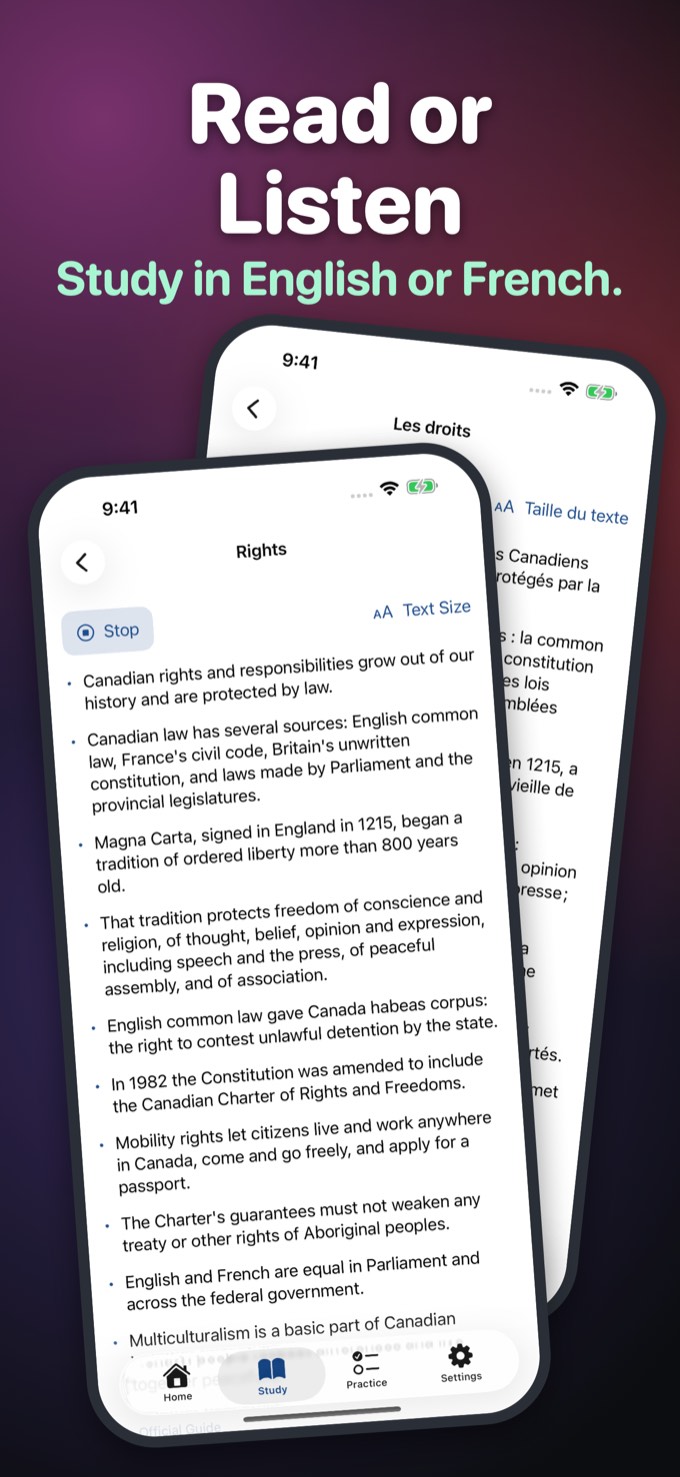
Captioned App Store image: Read or Listen, study in English or French, above the Rights chapter in English and French

Inside the app

Practise, then see where you stand.

A quiz after each section and a readiness view for every chapter.

01

Section quizzes

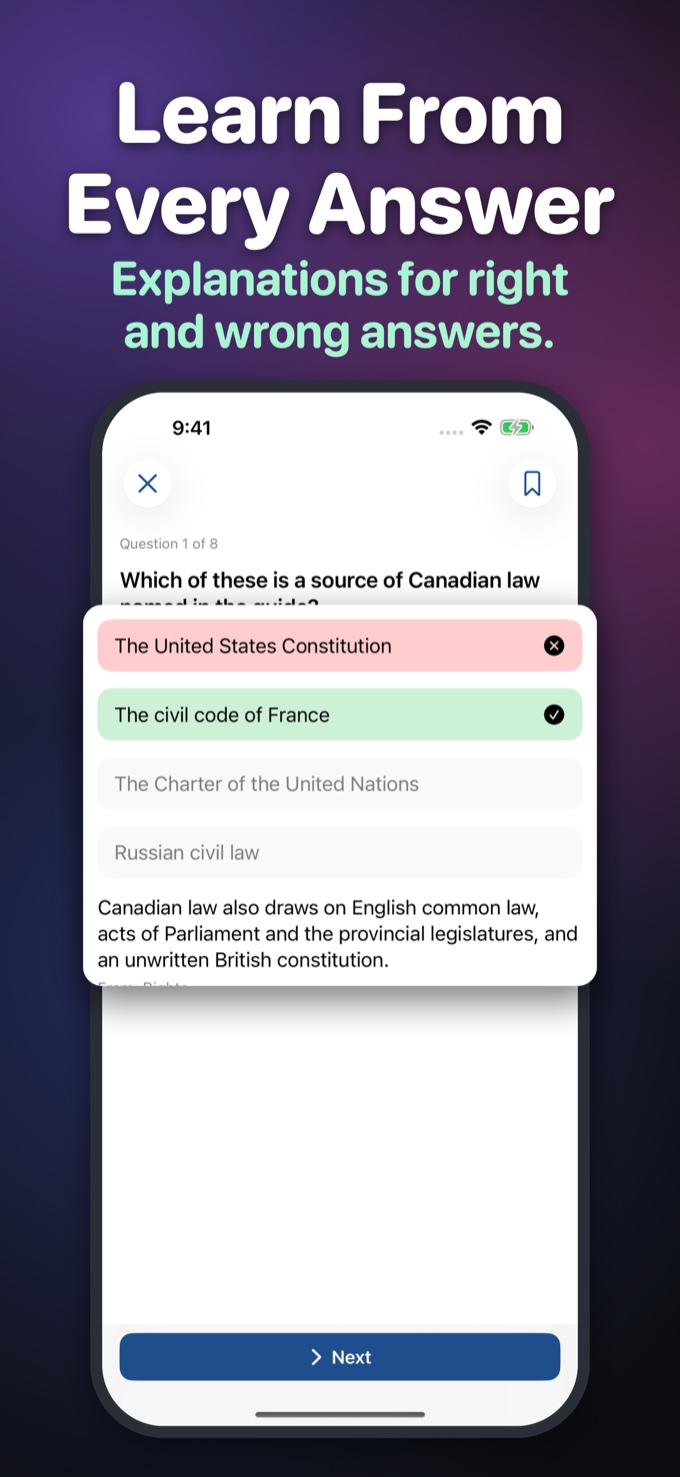
Learn from every answer

A quiz after each section, with a short explanation for every answer.

Captioned App Store image: Learn From Every Answer, explanations for right and wrong answers, above a quiz question with the wrong choice in red and the right answer in green
02

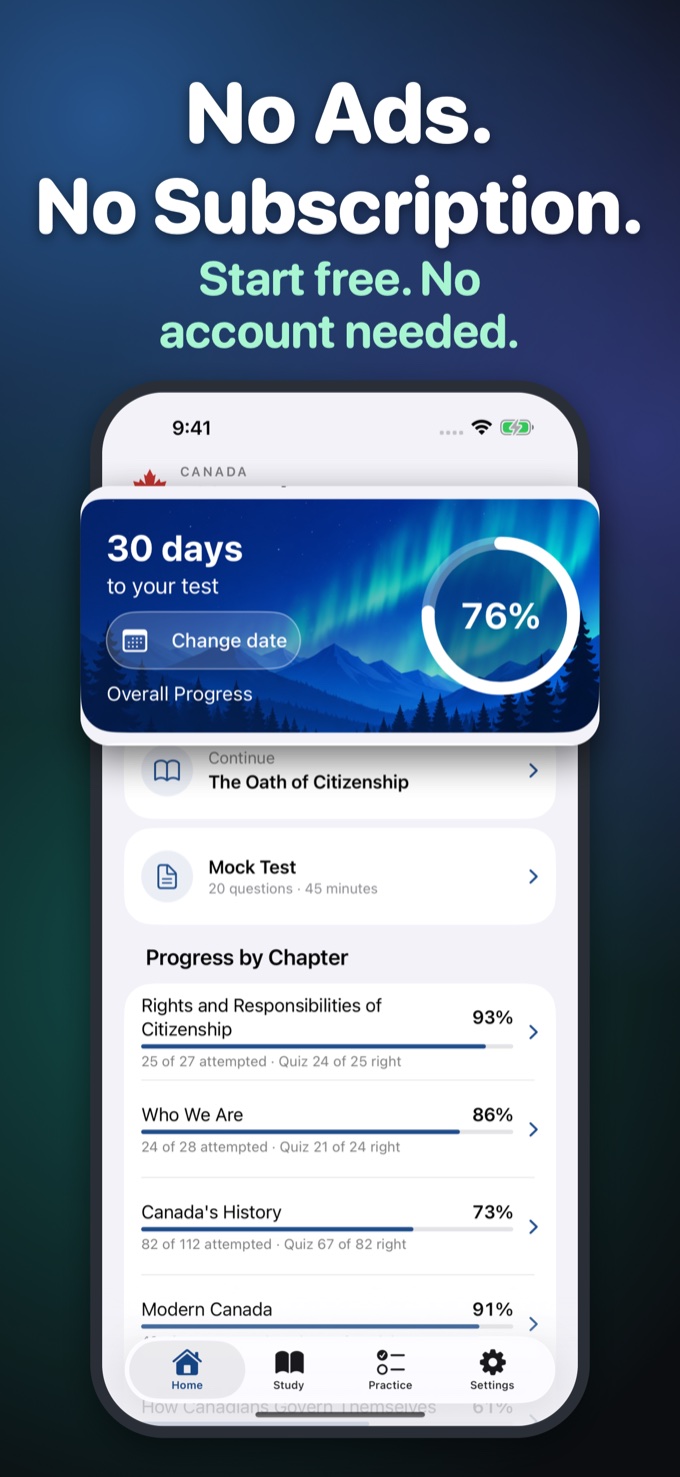
Readiness by chapter

Know what to review

See which parts of the guide you already know, chapter by chapter.

Captioned App Store image: No Ads. No Subscription. Start free, no account needed, above the Home screen showing progress by chapter

Support & enquiries

We’re here to help.

For app support or general enquiries, send us a note.

Also see the US citizenship practice test.